Smithsonian magazine has a recent article (2008) on Gobekli Tepe, which is 300 miles from Catalhoyuk and is reliably dated to 11,000 years ago. One paragraph reads:
Unlike the stark plateaus nearby, Gobekli Tepe (the name means "belly hill" in Turkish) has a gently rounded top that rises 50 feet above the surrounding landscape. To Schmidt's eye, the shape stood out. "Only man could have created something like this," he says. "It was clear right away this was a gigantic Stone Age site." The broken pieces of limestone that earlier surveyors had mistaken for gravestones suddenly took on a different meaning.
What the article does not say, perhaps because it is a commonplace in the literature, is that "Belly Hill" may be a reproduction of a pregnant woman's shape. Which gives rise to rumination about a few of the motifs in monumental architecture. assuming that the present nomenclature has some relation to older names. Which may be a stretch.
The resistance to the idea the religion preceded argriculture, is not mentioned, but is a definite aspect of the history of interpreting these ruins. My not original (I am sure) take on this is that the resistance was because if religion predated domesticated plants, then you could not so easily argue that man's manifestations of religious beliefs were a secondary development, and not related to man's fundamental ature. Possibly their current attitude that the symbolism is too old to reliably interpret is another stab at avoiding that conclusion.
Nothing though can diminish the amazement at these discoveries.
Saturday, June 25, 2016


Tuesday, June 14, 2016
Monday, June 13, 2016
"Baby Alien Worlds"
The full article is at space.com
"Baby alien worlds are indeed likely slicing gaps in the disk of dust and gas swirling around the young star HL Tauri — a finding that could help reshape scientists' current understanding of how planets form.
Astronomers found that some of the rings in the disk's gaseous component line up with rings in the dust, further supporting the theory that exoplanets are coalescing there — and suggesting that alien worlds may form much more quickly than scientists had thought.
"To our surprise, these gaps in the gas overlap with dust gaps," lead author Hsi-Wei Yen, a researcher at the Academia Sinica Institute of Astronomy and Astrophysics in Taiwan, said in a statement. "This supports the idea that the gaps are the footprints left by baby planets. Our results indicate that planets start to form much earlier than we expected."
Baby?
Alien?
Saturday, June 11, 2016
Diamond Planets might exist and might have been the origin of life
Excerpted from:
cit http://earthsky.org/space/universes-first-life-on-diamond-planets
Earth, Mars, and Venus are composed mostly of silicate rocks, with an iron core and a thin veneer of water and life. But since 2005, astronomers have been talking about a theoretical kind of planet called a carbon planet, which astronomers also call a diamond planet. The discussion about them ramped up when Jupiter wasproposed in 2004 to have formed a carbon-rich core. On June 7, 2016, astronomers at the Harvard-Smithsonian Center for Astrophysics in Boston announced a new study suggesting that the first potentially habitable worlds to form might have been carbon planets. That is, they might have consisted mostly of graphite, carbides, and diamond.
.......
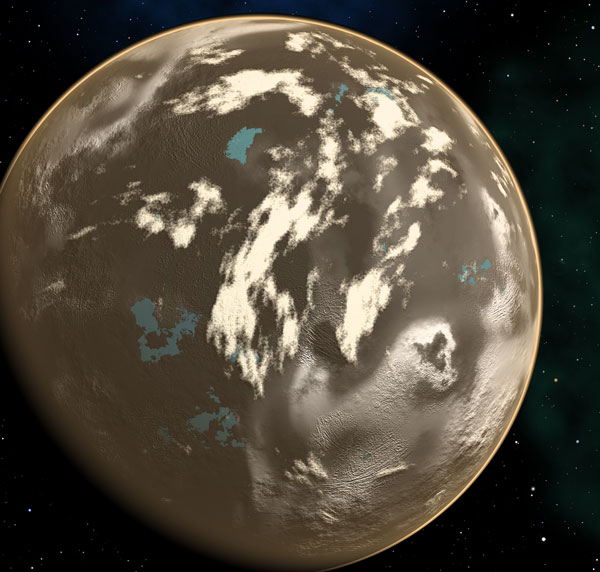
Artist’s concept of a hypothetical carbon planet, also called a diamond planet by astronomers. Images via Christine Pulliam (CfA)/ NASA/ SDO.
Mashian and her PhD thesis advisor Avi Loeb of the Harvard-Smithsonian Center for Astrophysics examined a particular class of ancient stars known as carbon-enhanced metal-poor stars, or CEMP stars. These stars contain only one hundred-thousandth as much iron as our sun.
The astronomers explained in their statement that – because the universe was born with mostly hydrogen and helium, with heavier elements born inside stars and spread throughout space via supernova explosions – they know the metal-poor stars in their study were born early in the history of our universe.
That is, they were born before the interstellar space had been widely seeded with heavy elements. Loeb explained:
These stars are fossils from the young universe. By studying them, we can look at how planets, and possibly life in the universe, got started.
The astronomers said that, although lacking in iron and other heavy elements compared to our sun, the ancient CEMP stars they studied were observed to have more carbon than would be expected given their age. They said:
This relative abundance would influence planet formation as fluffy carbon dust grains clump together to form tar-black worlds.
Mashian and Loeb propose that a dedicated search for planets around CEMP stars, in order to find diamond planets. They note that – from a distance, these carbon planets would be difficult to tell apart from silicate-based Earth-like worlds. Their masses and physical sizes would be similar (see the illustration below).
Astronomers would have to examine their atmospheres for signs of their true nature, they explained, since gases like carbon monoxide and methane would envelop these unusual worlds.
Mashian and Loeb said the search might be accomplished using the transit technique, that is, by looking for the tiny dip in the light of a distant star as an unknown planet passes in front of it. A large fraction of the known exoplanets, or planets orbiting other suns, were found via this technique.
......
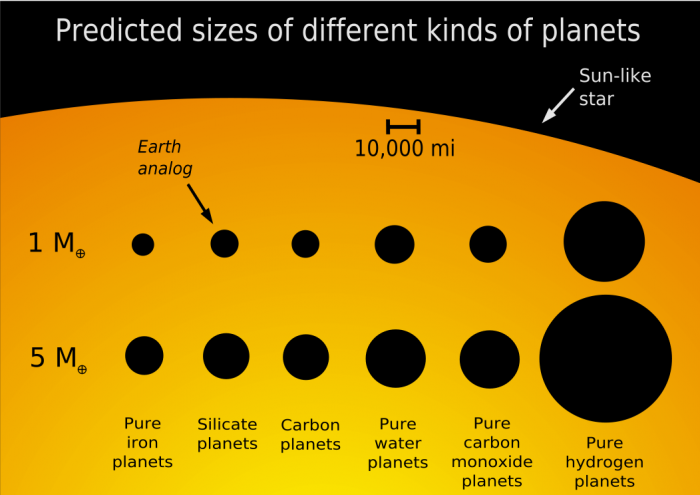
Size comparison of differently composed planets, via NASA’s Goddard Space Flight Center.
...
Thursday, June 9, 2016
New observations of black hole growth
At
http://www.newswise.com/articles/view/654955/?sc=swhn
a previously unobserved process of black hole growth
reported in
Newswise — An international team of astronomers using the Atacama Large Millimeter/submillimeter Array (ALMA) has witnessed a never-before-seen cosmic weather event – a cluster of towering intergalactic gas clouds raining in on the supermassive black hole at the center of an elliptical galaxy one billion light-years from Earth.
The new ALMA observations are the first direct evidence that cold dense clouds can coalesce out of hot intergalactic gas and plunge into the heart of a galaxy to feed its central supermassive black hole. They also reshape astronomers’ views on how supermassive black holes feed through a process known as accretion.
Previously, astronomers believed that, in the largest galaxies, supermassive black holes fed on a slow and steady diet of hot ionized gas from the galaxy’s halo. The new ALMA observations show that, when the intergalactic weather conditions are right, black holes can also gorge on a clumpy, chaotic downpour of giant, very cold clouds of molecular gas.
"This so-called cold, chaotic accretion has been a major theoretical prediction in recent years, but this is one of the first unambiguous pieces of observational evidence for a chaotic, cold 'rain' feeding a supermassive black hole," said Grant Tremblay, an astronomer with Yale University in New Haven, Connecticut, and lead author on a paper appearing in the journal Nature. "It's exciting to think we might actually be observing this galaxy-spanning 'rainstorm' feeding a black hole whose mass is about 300 million times that of our Sun."
Tremblay and his team used ALMA to peer into a phenomenally bright cluster of about 50 galaxies, collectively known as Abell 2597. At its core is a singular massive elliptical galaxy, pragmatically dubbed the Abell 2597 Brightest Cluster Galaxy. Suffusing the space between these galaxies is a diffuse atmosphere of hot, ionized plasma, which was previously observed with NASA’s Chandra X-ray Observatory.
"This very, very hot gas can quickly cool, condense, and precipitate in much the same way that warm, humid air in Earth's atmosphere can spawn rain clouds and precipitation," Tremblay said. "The newly condensed clouds then rain in on the galaxy, fueling star formation and feeding its supermassive black hole."
Near the center of this galaxy, the researchers discovered this exact scenario: three massive clumps of cold gas careening toward the supermassive black hole in the galaxy’s core at 300 kilometers per second (roughly 670,000 miles per hour). Each cloud contains as much material as a million Suns and is tens of light-years across.
Normally, objects on that scale would be difficult to distinguish at these cosmic distances, even with ALMA’s amazing resolution.
They were revealed, however, by the billion light-year-long "shadows" they cast toward Earth. These shadows, known as absorption features, were formed by the in-falling gas clouds blocking out a portion of the bright background millimeter-wavelength light, which is emitted by electrons spiraling around magnetic fields very near the central supermassive black hole.
Additional data from the National Science Foundation's Very Long Baseline Array indicate that the gas clouds observed by ALMA are approximately 300 light-years from the central black hole, essentially teetering on the edge of being devoured, in astronomical terms.
While ALMA was only able to detect three of these clouds, the astronomers speculate that there may be thousands like them in the vicinity, setting up the black hole for a continued downpour that could fuel its activity well into the future.
The astronomers now plan to use ALMA in a broader search for these "rainstorms" in other galaxies to determine if such cosmic weather is as common as current theory suggests it to be.
Sunday, February 21, 2016
Where are the exomoons
A most interesting article on how our moon may have made our planet hospitable to life and thus a clue to whether there is life elsewhere in the universe. We excerpt:
...First, there’s the stark reality that life on Earth may not have happened at all without the starring role played by our own moon.
The Earth’s axis is tilted by 23.5 degrees relative to its motion around the sun. This tilt gives us seasons, and because this tilt is relatively small, seasons on Earth are mild: most places never get impossibly hot or unbearably cold. One thing that has been crucial for life is that this tilt has stayed the same for very long periods: for millions of years, the angle of tilt has varied by only a couple of degrees.
What has kept the Earth so steady? The gravity of our moon.
In contrast, Mars only has two tiny moons, which have negligible gravity. Without a stabilizing influence, Mars has gradually tumbled back and forth, its tilt ranging between 0 and 60 degrees over millions of years. Extreme changes in climate have resulted. Any Martian life that ever existed would have found the need to continually adapt very challenging.
Without our moon, the Earth, too, would likely have been subject to chaotic climate conditions, rather than the relative certainty of the seasons that stretches back deep into the fossil record.
The gravity of the moon also produces the Earth’s tides. Billions of years ago, the ebb and flow of the oceans produced an alternating cycle of high and low salt content on ancient rocky shores. This recurring cycle could have enabled the unique chemical processes needed to generate the first DNA-like molecules.
...we shouldn’t be discouraged by the fact that most exoplanets found so far are bloated gaseous beasts, with hostile environments unlikely to support life as we know it. What we don’t know yet, crucially, is whether these exoplanets have moons. This prospect is exciting, because exomoons are expected to be smaller rocky or icy bodies, possibly hosting oceans and atmospheres....
...First, there’s the stark reality that life on Earth may not have happened at all without the starring role played by our own moon.
The Earth’s axis is tilted by 23.5 degrees relative to its motion around the sun. This tilt gives us seasons, and because this tilt is relatively small, seasons on Earth are mild: most places never get impossibly hot or unbearably cold. One thing that has been crucial for life is that this tilt has stayed the same for very long periods: for millions of years, the angle of tilt has varied by only a couple of degrees.
What has kept the Earth so steady? The gravity of our moon.
In contrast, Mars only has two tiny moons, which have negligible gravity. Without a stabilizing influence, Mars has gradually tumbled back and forth, its tilt ranging between 0 and 60 degrees over millions of years. Extreme changes in climate have resulted. Any Martian life that ever existed would have found the need to continually adapt very challenging.
Without our moon, the Earth, too, would likely have been subject to chaotic climate conditions, rather than the relative certainty of the seasons that stretches back deep into the fossil record.
The gravity of the moon also produces the Earth’s tides. Billions of years ago, the ebb and flow of the oceans produced an alternating cycle of high and low salt content on ancient rocky shores. This recurring cycle could have enabled the unique chemical processes needed to generate the first DNA-like molecules.
...we shouldn’t be discouraged by the fact that most exoplanets found so far are bloated gaseous beasts, with hostile environments unlikely to support life as we know it. What we don’t know yet, crucially, is whether these exoplanets have moons. This prospect is exciting, because exomoons are expected to be smaller rocky or icy bodies, possibly hosting oceans and atmospheres....
Friday, February 19, 2016
Thinking at a Distance
Nice story about plants that can camouflage themselves.
http://phenomena.nationalgeographic.com/2016/02/19/the-sneaky-life-of-the-worlds-most-mysterious-plant/
The use of superlative and the adjective "sneaky," in the title, "The sneaky life of the world's most mysterious plant," suggests the authors may never discover mysteries at lot closer than the Amazon jungle. That of course is just one of many things I do not know.
http://phenomena.nationalgeographic.com/2016/02/19/the-sneaky-life-of-the-worlds-most-mysterious-plant/
The use of superlative and the adjective "sneaky," in the title, "The sneaky life of the world's most mysterious plant," suggests the authors may never discover mysteries at lot closer than the Amazon jungle. That of course is just one of many things I do not know.
Friday, February 5, 2016
Beauty and knowledge
Who we are must surely be connected with what we are a part of. This article talks about speculation regarding galaxy formation. What if knowledge must proceed looking outward and looking inward, at the same time, and also adjacently. Could be. Could explain the thrill non-scientists feel when some topics are broached.
Tuesday, October 13, 2015
Marilynne Robinson
Jan Cox once said, in the 1970s, that religion, that which ordinary talk refers to by that word, was putrid. It was not always that way. He said at times in history the church "had sheltered," the work. He wouldn't have had any reason to refer to Marilynne Robinson, if he knew of her.
At the link there is an essay by this writer which places the way religion is used in political life in a context which values religion. I sway into her words, and am thankful someone can speak with her authenticity. I have no idea how viable this 'edge of the ordinary' is.
https://www.commonwealmagazine.org/awakening?utm_source=Main+Reader+List&utm_campaign=8ebfda6509-August+11_Now_at_Commonweal8_11_2015&utm_medium=email&utm_term=0_407bf353a2-8ebfda6509-92372181
At the link there is an essay by this writer which places the way religion is used in political life in a context which values religion. I sway into her words, and am thankful someone can speak with her authenticity. I have no idea how viable this 'edge of the ordinary' is.
https://www.commonwealmagazine.org/awakening?utm_source=Main+Reader+List&utm_campaign=8ebfda6509-August+11_Now_at_Commonweal8_11_2015&utm_medium=email&utm_term=0_407bf353a2-8ebfda6509-92372181
Wednesday, September 16, 2015
Suddenly we know what quasars are!?
Suddenly we know what quasars are!? When did we figure that out.
http://phys.org/news/2015-09-converging-black-holes-virgo-constellation.html?utm_source=nwletter&utm_medium=email&utm_content=splt-item&utm_campaign=daily-nwletter
....
Read more at: http://phys.org/news/2015-09-converging-black-holes-virgo-constellation.html#jCp
http://phys.org/news/2015-09-converging-black-holes-virgo-constellation.html?utm_source=nwletter&utm_medium=email&utm_content=splt-item&utm_campaign=daily-nwletter
....
A supermassive black hole about to cannibalize its own can be detected by the mysterious flickering of a quasar—the beacon of light produced by black holes as they burn through gas and dust swirling around them. Normally, quasars brighten and dim randomly, but when two black holes are on the verge of uniting, the quasar appears to flicker at regular intervals, like a light bulb on timer......
Read more at: http://phys.org/news/2015-09-converging-black-holes-virgo-constellation.html#jCp
Wednesday, July 29, 2015
Lithium stellar quantities still a mystery
Our title is not the one used by this article:
http://www.reuters.com/article/2015/07/29/us-science-nova-chile-idUSKCN0Q314920150729?
The Reuters title is "Lithium find in exploding star could help solve astronomy puzzle."
My point is the skew to presenting the physical sciences in a particular light. Why NOT present the gaps in our ignorance more boldly in articles popularizing scientific progress?
We quote from the article:
":If we imagine the history of the chemical evolution of the Milky Way as a big jigsaw, then lithium from novae was one of the most important and puzzling missing pieces..."
Actually this article is fairly fair compared to many I read. So the fact they say---lithium from novae was one of the most important and puzzling missing pieces... supports my point. In fact, the lithium quantities still are a mystery, as the end of the article makes clear. And what if our progress is not just filling in empty pre-shaped spots in a grid? What if what we don't know defines the whole puzzle?
http://www.reuters.com/article/2015/07/29/us-science-nova-chile-idUSKCN0Q314920150729?
The Reuters title is "Lithium find in exploding star could help solve astronomy puzzle."
My point is the skew to presenting the physical sciences in a particular light. Why NOT present the gaps in our ignorance more boldly in articles popularizing scientific progress?
We quote from the article:
":If we imagine the history of the chemical evolution of the Milky Way as a big jigsaw, then lithium from novae was one of the most important and puzzling missing pieces..."
Actually this article is fairly fair compared to many I read. So the fact they say---lithium from novae was one of the most important and puzzling missing pieces... supports my point. In fact, the lithium quantities still are a mystery, as the end of the article makes clear. And what if our progress is not just filling in empty pre-shaped spots in a grid? What if what we don't know defines the whole puzzle?
Sunday, July 26, 2015
How do scientists synchronize themselves
Fascinating article on how things synchronize in nature. My interest though is how science popularizers talk. The whole buildup is this old mystery and how it gets solved. Then the last paragraph walks it all back. This is typical. Read the article from the link -- I only excerpted a bit.
Quoting from a Smithsonian article...
Christiaan Huygens was a busy scholar. Among his many achievements, the Dutch scientist figured out the shape of Saturn's rings and discovered that planet's largest moon, Titan. He founded the theory that light travels as a wave, and he invented the pendulum clock. Huygens, it seems, couldn't even turn off his scientific mind when he was under the weather.
In 1665 he was ill and stuck in bed, watching two pendulum clocks that were attached to a beam in his house. He noticed the pendulums started to swing in time with each other, no matter whether the clocks had been started or stopped at different times or what position the pendulums started in. Huygens was baffled. There had to be some way the clocks "spoke" to each other, but he lacked the precise instruments necessary to measure interaction between the clocks. So he chalked it up to mysterious movements transmitted by the air or the physical connection in the beam, and there the matter rested for more than 300 years.
Now, physicists revisiting the 17th-century conundrum think the answer may lie in sound waves. ......
Jonatan Peña Ramirez, a researcher at the Technical University of Eindhoven in the Netherlands, has also published studies of the Huygens' clock phenomenon. He says physicists like to study this system because it mimics other cycles in nature. "Similar phenomena can be observed in biological systems, where some cycles inside the human body may synchronize in a natural way," he says.
However, he isn't yet convinced that sound energy is the culprit for the clocks. "If you replace the driving mechanism in the clocks by a smooth mechanism, i.e., a mechanism that does not apply [discrete] impulses to the clocks, still one can be able to observe synchronization," he says. As far as he's concerned, "Huygens' synchronization … is far from being solved."
Read more: http://www.smithsonianmag.com/science-nature/can-sound-explian-350-year-old-clock-mystery-180956022/#9ekmf3VpK0pO95pB.99
Give the gift of Smithsonian magazine for only $12! http://bit.ly/1cGUiGv
Follow us: @SmithsonianMag on Twitter
Tuesday, June 16, 2015
Is the cat saved or multiplied even more
Some scientists think the relation of macro and micro reality is elucidated by time dilation. Not that I actually understand the math or anything, but it does seem to me that instead of micro and macro realities, you might just have many more gradations between quantum and macro realities --- but that is not what we experience -- I don't think.
Tuesday, April 21, 2015
Mysterious cold spot in the universe
There is a mysterious cold spot in the universe and an empty spot according to The Independent.
The concluding paragraph:
The Hawaii scientists said that while “the existence of the supervoid and its expected effect on the CMB do not fully explain the Cold Spot, it is very unlikely that the supervoid and the Cold Spot at the same location are a coincidence”. The team will continue to study the cold spot using extra data, they said.
Is 'extra data' just an infelicitous expression? It suggests people scooping up some chads from a laboratory floor. Popular science is the point where sloppy thinking meets something that could be interesting.
AND AN UPDATE to this story-- comparing the Guardian version of this story we find a void in the Independent's reporting----
The Guardian says:
....The supervoid is not an actual vacuum, as its name suggests, but has about 20% less stuff in it than our part of the universe – or any typical region. “Supervoids are not entirely empty, they’re under-dense,” said András Kovács, a co-author at the Eötvös Loránd University in Budapest.
And this quote compares instructively with the below, from The Independent article cited at the start of this post:
The ‘supervoid’ is 1.8 billion light years wide, ‘the largest individual structure ever identified by humanity’ and full of absolutely nothing.
The concluding paragraph:
The Hawaii scientists said that while “the existence of the supervoid and its expected effect on the CMB do not fully explain the Cold Spot, it is very unlikely that the supervoid and the Cold Spot at the same location are a coincidence”. The team will continue to study the cold spot using extra data, they said.
Is 'extra data' just an infelicitous expression? It suggests people scooping up some chads from a laboratory floor. Popular science is the point where sloppy thinking meets something that could be interesting.
AND AN UPDATE to this story-- comparing the Guardian version of this story we find a void in the Independent's reporting----
The Guardian says:
....The supervoid is not an actual vacuum, as its name suggests, but has about 20% less stuff in it than our part of the universe – or any typical region. “Supervoids are not entirely empty, they’re under-dense,” said András Kovács, a co-author at the Eötvös Loránd University in Budapest.
And this quote compares instructively with the below, from The Independent article cited at the start of this post:
The ‘supervoid’ is 1.8 billion light years wide, ‘the largest individual structure ever identified by humanity’ and full of absolutely nothing.
We at least know this: they are not both quoting the wikipedia source.
Saturday, April 11, 2015
More light on dark energy
http://phys.org/news/2015-04-universe-fast.html?
and meanwhile, at Fermilab--
"Absence of gravitational-wave signal extends limit on knowable universe"
So all our measurements are off, and, there are no cosmic strings close by. Something's moving faster. All I can say is that "chipping away at the universe," is bad writing.
and meanwhile, at Fermilab--
"Absence of gravitational-wave signal extends limit on knowable universe"
http://phys.org/news/2015-04-absence-gravitational-wave-limit-knowable-universe.html?
So all our measurements are off, and, there are no cosmic strings close by. Something's moving faster. All I can say is that "chipping away at the universe," is bad writing.
Thursday, April 9, 2015
Great book on Heidegger just published
Heidegger's Confessions: The Remains of Saint Augustine in "Being and Time" and Beyond (2015) . Ryan Coyne.
I really hope it gets the attention it deserves for illuminating Heidegger's methods of analysis. The recent revelations of the extent of Heidegger's ghastly prejudices, which for instance have led to the resignation of the German head of a society to study Heidegger, were made after this book went to press, may make many just want his work to disappear. Still we need to understand the role he played. An sense of disdain for this thinker does not mean his effect on European thought can be ignored.
Ryan Coyne was a student of Amy Hollywood. Enough is available to sample at gbooks to get a sense of the quality of this book.
I really hope it gets the attention it deserves for illuminating Heidegger's methods of analysis. The recent revelations of the extent of Heidegger's ghastly prejudices, which for instance have led to the resignation of the German head of a society to study Heidegger, were made after this book went to press, may make many just want his work to disappear. Still we need to understand the role he played. An sense of disdain for this thinker does not mean his effect on European thought can be ignored.
Ryan Coyne was a student of Amy Hollywood. Enough is available to sample at gbooks to get a sense of the quality of this book.
Wednesday, April 8, 2015
A link to the formation of the moon
Fascinating read, didn't quite understand the point, but it is nice to think physics is getting a scenario of how the earth and moon formed.
http://phys.org/news/2015-04-view-moon-formation-crucial-difference.html?utm_source=nwletter&utm_medium=email&utm_content=splt-item&utm_campaign=daily-nwletter
http://phys.org/news/2015-04-view-moon-formation-crucial-difference.html?utm_source=nwletter&utm_medium=email&utm_content=splt-item&utm_campaign=daily-nwletter
Monday, March 16, 2015
Mad and mad
I am just kind of tucking this away here: an article about how kids in foster settings are drugged. What I know that most don't is how this is functional in a larger context. But I don't know how to express this so that something is communicated that does not seem heartless.
http://www.madinamerica.com/2015/03/drugging-children-foster-care/
http://www.madinamerica.com/2015/03/drugging-children-foster-care/
Friday, January 23, 2015
Good and bad and ....
quoting the headline from an Aeon article
The point of this brief mention is that above is a great example of binary thought. " Technological progress" is GOOD, OR is BAD. Wait though, it is both, of course it is both. Technological progress is good and it is bad. This obviousness is hidden because we see above our rational, ordinary mind at work. Our binary mind--- everything has to be this or that. Two choices. Both/and is ignored.
Colin Dickey
Is not both/and also binary? But it points to a greater complexity, and really, considering the point of this post, we have to say reality surely is either/or AND, it is at the same time, BOTH/AND.
I can't help this reality--- I didn't make this planet.
I can't help this reality--- I didn't make this planet.
Friday, December 26, 2014
MYcrobes or Ourcrobes
Sometimes this space features egregrious examples of fallacious thinking. Today though we excerpt an article from an Oxford University Press blog. We like it for a complex look at man's interconnectedness. We like it so much we will not even stress how it understates this interconnectedness.
Missing the opportunity to learn something about microbiology is a mistake. The uninformed are likely to be left with a distorted view of biology in which they miscast themselves as the most important organisms. For example, “Sarah” is a significant manifestation of life from Sarah’s perspective, but her body is not the individual organism that she imagines, and nor, despite her talents, is she a major player in the ecology of the planet. Her interactions with microbes will include a healthy relationship with bacteria in her gut, bouts of influenza and other viral illnesses, and death in old age from an antibiotic-resistant infection. Sarah’s microbiology will continue after death with her decomposition by fungi. In happier times she will become an expert on Milton’s poetry, and delight students by reciting Lycidas through her tears, but she will never know a thing about microbiology. This is a pity. Learning about viruses that bloom in seawater and fungi that sustain rainforests would not have stopped her from falling in love with Milton.
Missing the opportunity to learn something about microbiology is a mistake. The uninformed are likely to be left with a distorted view of biology in which they miscast themselves as the most important organisms. For example, “Sarah” is a significant manifestation of life from Sarah’s perspective, but her body is not the individual organism that she imagines, and nor, despite her talents, is she a major player in the ecology of the planet. Her interactions with microbes will include a healthy relationship with bacteria in her gut, bouts of influenza and other viral illnesses, and death in old age from an antibiotic-resistant infection. Sarah’s microbiology will continue after death with her decomposition by fungi. In happier times she will become an expert on Milton’s poetry, and delight students by reciting Lycidas through her tears, but she will never know a thing about microbiology. This is a pity. Learning about viruses that bloom in seawater and fungi that sustain rainforests would not have stopped her from falling in love with Milton.
Subscribe to:
Posts (Atom)